


Starting each day with purpose means recognizing opportunities to create value. In today’s digital landscape, Micro SaaS represents one of the most accessible paths to entrepreneurial success. This comprehensive guide transforms complex business concepts into actionable steps anyone can follow.
Understanding the Micro SaaS Foundation
Micro SaaS stands for subscription-based software that solves specific problems for niche audiences. Unlike traditional SaaS companies, which require massive funding and teams, Micro SaaS operates with minimal resources and maximum impact.
“Micro SaaS democratizes entrepreneurship by removing traditional barriers while maintaining the potential for substantial returns.”
The beauty lies in its simplicity. You identify a problem, create a solution, and build recurring revenue. Rick Blyth, who scaled his Micro SaaS apps to $10k monthly recurring revenue before selling, demonstrates this approach works consistently.
Core Characteristics of Successful Micro SaaS
Every successful Micro SaaS shares essential traits:
- Targeted problem-solving for specific niches
- Subscription-based revenue creates predictable income
- Solo founder or micro team operations
- Bootstrap funding without external investors
- Scalable solutions serving multiple customers simultaneously
These characteristics create sustainable business models that grow organically over time.
The Four Types of Micro SaaS Platforms
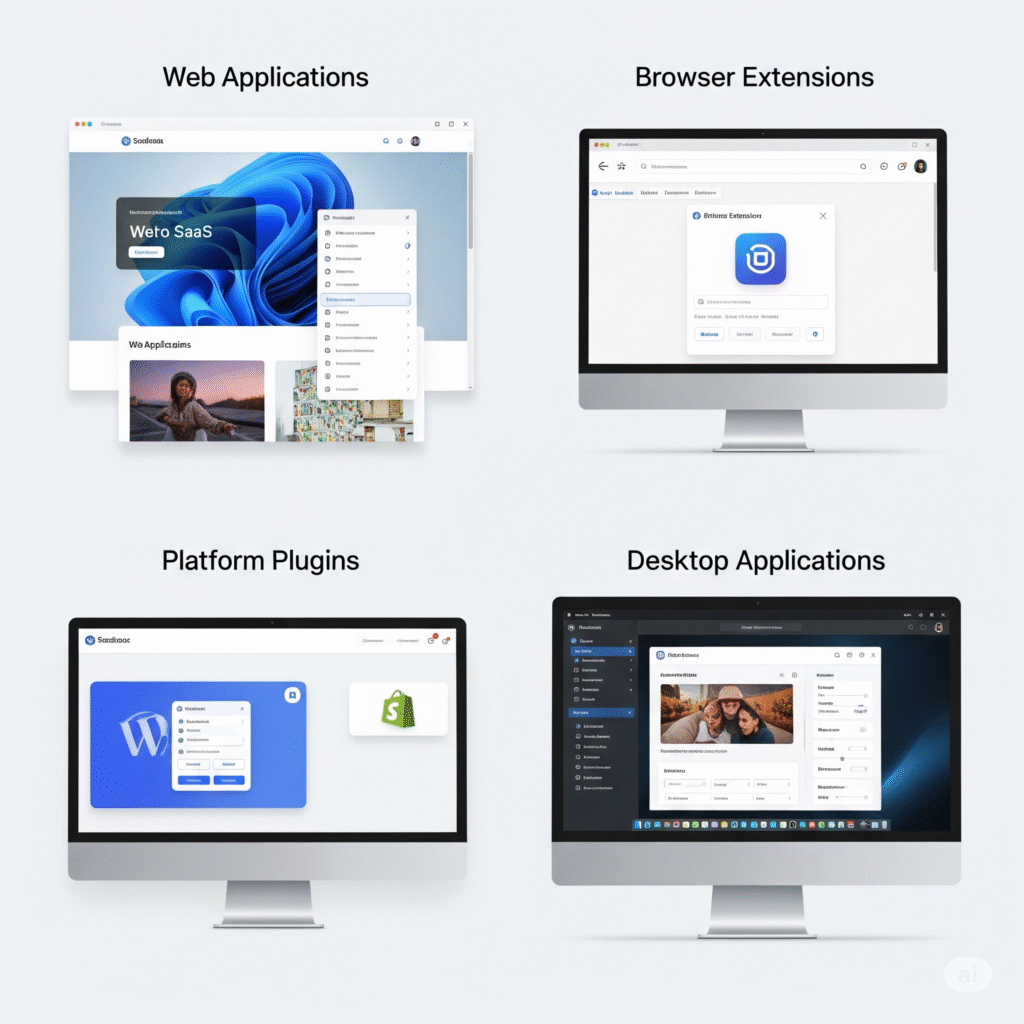
Understanding different platform types helps you choose the right approach for your skills and market.
Web Applications: The Foundation Platform
Web apps represent the mainstream Micro SaaS approach. Examples include:
- HypeJury: Twitter scheduling and posting automation
- Upvote: User feedback and product roadmap management
- Browserless: Developer-focused browser automation services
Web applications offer maximum flexibility but require more technical setup initially.
Browser Extensions: Quick Market Entry
Browser extensions provide the fastest path to market validation. Jordan O’Connor’s Closet Tools exemplifies this success, generating $35,000 monthly by solving his wife’s repetitive tasks on Poshmark.
Extension benefits include:
- Lower development complexity
- Built-in distribution through browser stores
- Immediate user discovery
- Faster iteration cycles
Platform Plugins: Leveraging Existing Ecosystems
Plugin development taps into established marketplaces like Shopify, WordPress, or Slack. SuperLemon’s WhatsApp integration for Shopify demonstrates how two developers created $25,000 monthly revenue within existing ecosystems.
Platform advantages:
- Reduced marketing requirements
- Built-in customer discovery
- Established payment systems
- Clear problem identification
Desktop Applications: Specialized Solutions
Desktop apps serve specific professional needs. TextExpander shows how simple concepts can evolve into comprehensive solutions with advanced features and cross-device synchronization.
Your 10-Step Micro SaaS Development Framework
Phase 1: Foundation (Steps 1-3)
Step 1: Problem Identification Start with problems you personally experience. The best Micro SaaS solutions often begin as founders scratching their own itch. Document specific pain points in your daily work or personal activities.
Step 2: Market Validation Before writing code, validate demand. Use social media, forums, and direct conversations to confirm others share your problem. Look for existing partial solutions and their limitations.
Step 3: Competitive Analysis Study existing solutions in your chosen niche. Identify gaps, pricing strategies, and user complaints. This research guides your unique value proposition.
Phase 2: Development (Steps 4-6)
Step 4: MVP Design. Create the minimum viable product, focusing on core problem-solving. Avoid feature creep initially. Your first version should address one specific pain point exceptionally well.
Step 5: Technical Implementation Choose technologies matching your skill level. Simple solutions often outperform complex ones. Focus on functionality over flashy features.
Step 6: User Testing: Test with real users before public launch. Gather feedback on usability, value proposition, and pricing expectations. Iterate based on genuine user needs.
Phase 3: Launch (Steps 7-8)
Step 7: Soft Launch Release to a limited audience first. Use this phase to identify bugs, refine onboarding, and gather testimonials. Perfect your support processes.
Step 8: Marketing Strategy Develop sustainable customer acquisition methods. Content marketing, SEO, and community engagement often prove more effective than paid advertising for Micro SaaS.
Phase 4: Growth (Steps 9-10)
Step 9: Revenue Optimization Analyze pricing strategies, reduce churn, and increase customer lifetime value. Focus on metrics that directly impact recurring revenue.
Step 10: Scaling Decisions Determine whether to expand features, target new markets, or prepare for exit. Each path requires different strategies and resources.
“Success in Micro SaaS comes from consistent execution of simple principles rather than complex strategies.”
Building Sustainable Revenue Models

Revenue sustainability depends on understanding subscription dynamics and customer behavior patterns.
Pricing Strategy Framework
Effective pricing balances affordability with profitability:
- Freemium Model: Attract users with free features, convert to paid plans
- Tiered Pricing: Multiple plans serving different customer segments
- Usage-Based: Pricing scales with customer value received
- Flat Rate: Simple pricing for straightforward solutions
Key Metrics to Monitor
Track these essential metrics monthly:
- Monthly Recurring Revenue (MRR): Core business health indicator
- Customer Acquisition Cost (CAC): Marketing efficiency measure
- Customer Lifetime Value (CLV): Long-term profitability gauge
- Churn Rate: Customer retention effectiveness
Revenue Growth Strategies
Sustainable growth requires multiple approaches:
Customer Retention Focus: Existing customers provide the foundation for growth. Implement strong onboarding, responsive support, and continuous value delivery.
Feature Expansion: Add complementary features that increase customer stickiness. Each feature should solve additional problems within your core niche.
Market Expansion Once successful in one niche, carefully expand to adjacent markets with similar problems.
Overcoming Common Challenges
Technical Challenges
Solution: Start simple and iterate. Many successful Micro SaaS solutions begin with basic functionality that improves over time.
Marketing Difficulties
Solution: Focus on content marketing and community building. Share your journey, provide value, and build relationships within your target niche.
Time Management
Solution: Treat Micro SaaS as a side project initially. Dedicate specific hours weekly and maintain consistency over intensity.
Competition Concerns
Solution: Differentiate through superior customer experience rather than features alone. Build strong relationships with your user base.
“The most successful Micro SaaS founders focus on solving real problems exceptionally well rather than building the most features.”
Essential Tools and Resources
Development Tools
- No-code platforms: Bubble, Webflow for non-technical founders
- Low-code solutions: Zapier, Airtable for rapid prototyping
- Traditional development: React, Vue.js for custom solutions
Business Tools
- Analytics: Google Analytics, Mixpanel for user behavior
- Payment processing: Stripe, PayPal for subscriptions
- Customer support: Intercom, Zendesk for user communication
- Email marketing: Convert kit, Mailchimp for user engagement
Learning Resources
The Micro SaaS Handbook provides comprehensive guidance from idea to exit, written by successful founder Rick Blyth.
Your Next Steps Toward Success
Starting your Micro SaaS journey requires action over perfection. Begin with these immediate steps:
- Document three problems you personally experience weekly
- Research existing solutions for each problem
- Talk to five potential users about their pain points
- Choose one problem with clear market demand
- Create a simple landing page describing your solution
“Every morning presents a fresh opportunity to move closer to your entrepreneurial goals through small, consistent actions.”
Remember that successful Micro SaaS businesses grow from solving real problems for real people. Focus on value creation over complexity, and sustainable growth will follow naturally.
The Micro SaaS model offers solo entrepreneurs an unprecedented opportunity to build profitable, scalable businesses with minimal startup costs. Your journey begins with the next problem you solve.
Start Building Your Micro SaaS Today
Ready to transform your idea into reality? Every successful Micro SaaS needs reliable, affordable hosting to reach customers worldwide.
Get started with professional web hosting that grows with your business →
Quality hosting provides the foundation for your Micro SaaS success. Choose a platform that offers:
- 99.9% uptime for consistent user access
- Scalable resources that expand with your growth
- Security features protecting your business and customers
- Expert support when you need technical assistance
Your Micro SaaS journey starts with the right infrastructure. Take the first step toward building your sustainable income stream today.
Editorial Note: This article provides practical guidance based on established Micro SaaS principles and real-world examples from successful founders like Rick Blyth. The strategies outlined reflect proven approaches for building sustainable subscription-based software businesses. All recommendations align with ethical business practices and sustainable growth methodologies.